
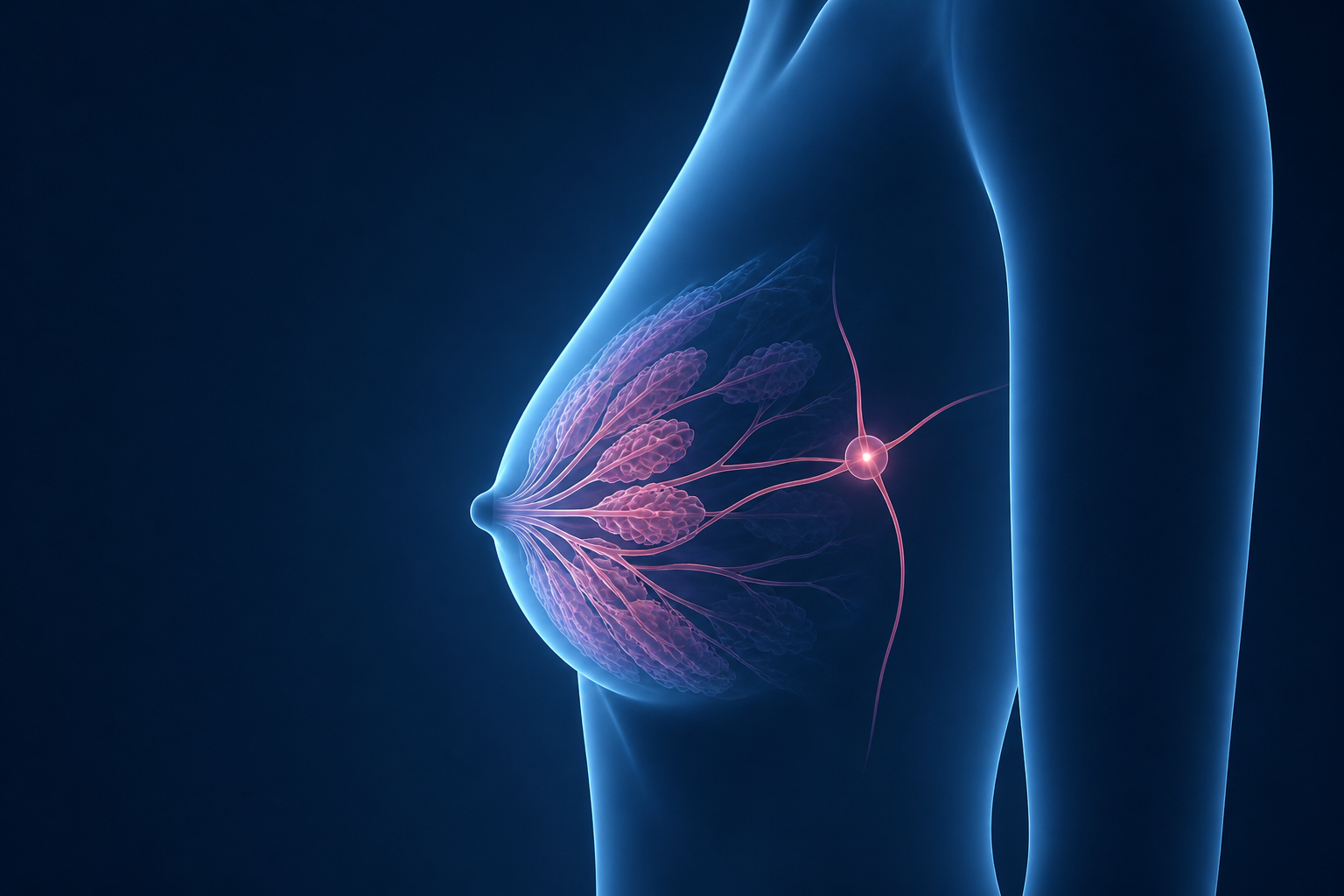
Breast imaging reports describe findings using precise radiological language. This section translates the most common findings into plain English - explaining what was seen, whether it requires further workup, and what the next steps typically are. Findings are grouped by their level of concern, from clearly benign to suspicious.
Benign (non-cancerous) breast lump
Fibroadenoma
The most common benign breast tumor, typically found in younger women. Usually a smooth, well-defined, mobile mass - often described as a "breast mouse." Learn how it appears on imaging, when it needs follow-up, and when biopsy is recommended.
Cysts
Fluid-filled sacs that are extremely common, especially in premenopausal women. Simple cysts are definitively benign on ultrasound and require no further workup. Learn the difference between simple, complicated, and complex cysts - and why only some need biopsy.
Fat Necrosis
Dead fatty tissue that develops after surgery, trauma, or radiation. Fat necrosis is benign but can look alarming on imaging - forming hard lumps, spiculated edges, and calcifications that closely mimic cancer. Learn why recognizing it matters and how it's confirmed.
Intramammary Lymph Node
A normal lymph node found within the breast tissue - a common, benign incidental finding on mammogram or ultrasound. Learn its classic imaging appearance (the kidney-bean shape with a fatty hilum), why it's reassuring when typical, and when it warrants further evaluation.
Common Findings on a Mammogram
Calcifications
Tiny calcium deposits in the breast - some are clearly benign, others are suspicious for early cancer (DCIS). The type, shape, distribution, and number of calcifications determine what happens next. This is the most nuanced finding in breast imaging and one of the most important.
Asymmetry
An area of the breast that looks different from the corresponding area on the other side. Not all asymmetries are concerning - many are normal anatomical variation. Learn the four types (asymmetry, focal asymmetry, developing asymmetry, global asymmetry) and what each means for follow-up.
Architectural Distortion
A disruption of the normal pattern of breast tissue - radiating lines pulling toward a central point, without a visible mass. One of the most easily missed mammographic findings and one of the most important. Can represent early cancer, a radial scar, or post-surgical scarring.
Mass
A three-dimensional space-occupying lesion visible on two views of the mammogram. The shape, margins, and density of a mass determine whether it's likely benign or suspicious. Learn how radiologists describe and categorize masses and what distinguishes a probably-benign from a suspicious mass.
C - High-Risk Lesions (Pathology)
Atypical Ductal Hyperplasia (ADH)
Abnormal cells in the milk ducts that are not yet cancer but raise lifetime breast cancer risk approximately 4–5 times above average. ADH found on biopsy often prompts surgical excision to ensure no DCIS or cancer is present nearby. Learn what ADH means and what follow-up is recommended.
Atypical Lobular Hyperplasia (ALH)
Abnormal cells in the lobules of the breast. Like ADH, ALH raises breast cancer risk approximately 4–5 times and is a marker for future risk throughout both breasts - not just the site where it was found. Learn how ALH differs from ADH and LCIS and what it means for your screening plan.
Lobular Carcinoma In Situ (LCIS)
Despite its name, LCIS is not cancer - it's an abnormal cell growth in the lobules that raises lifetime breast cancer risk approximately 7–12 times. It is a powerful risk marker for both breasts and typically qualifies a woman as high risk. Learn what LCIS means and how it changes your surveillance plan.
Radial Scar
A benign proliferative lesion with a characteristic star-shaped appearance on mammogram - one of the most important mimics of breast cancer on imaging. Because radial scars can harbor ADH, LCIS, or even cancer at the margins, surgical excision is typically recommended even when the biopsy appears benign.
Papilloma
A benign wart-like growth arising from the lining of the breast ducts. Intraductal papillomas are a common cause of nipple discharge. Solitary central papillomas are usually benign; multiple peripheral papillomas carry a higher risk of associated atypia and may require excision. Learn how they're found and what follow-up entails.
Have a breast imaging report? A board-certified radiologist with extensive experience in breast imaging reviews every explanation before it reaches you.
Get My Report Explained