
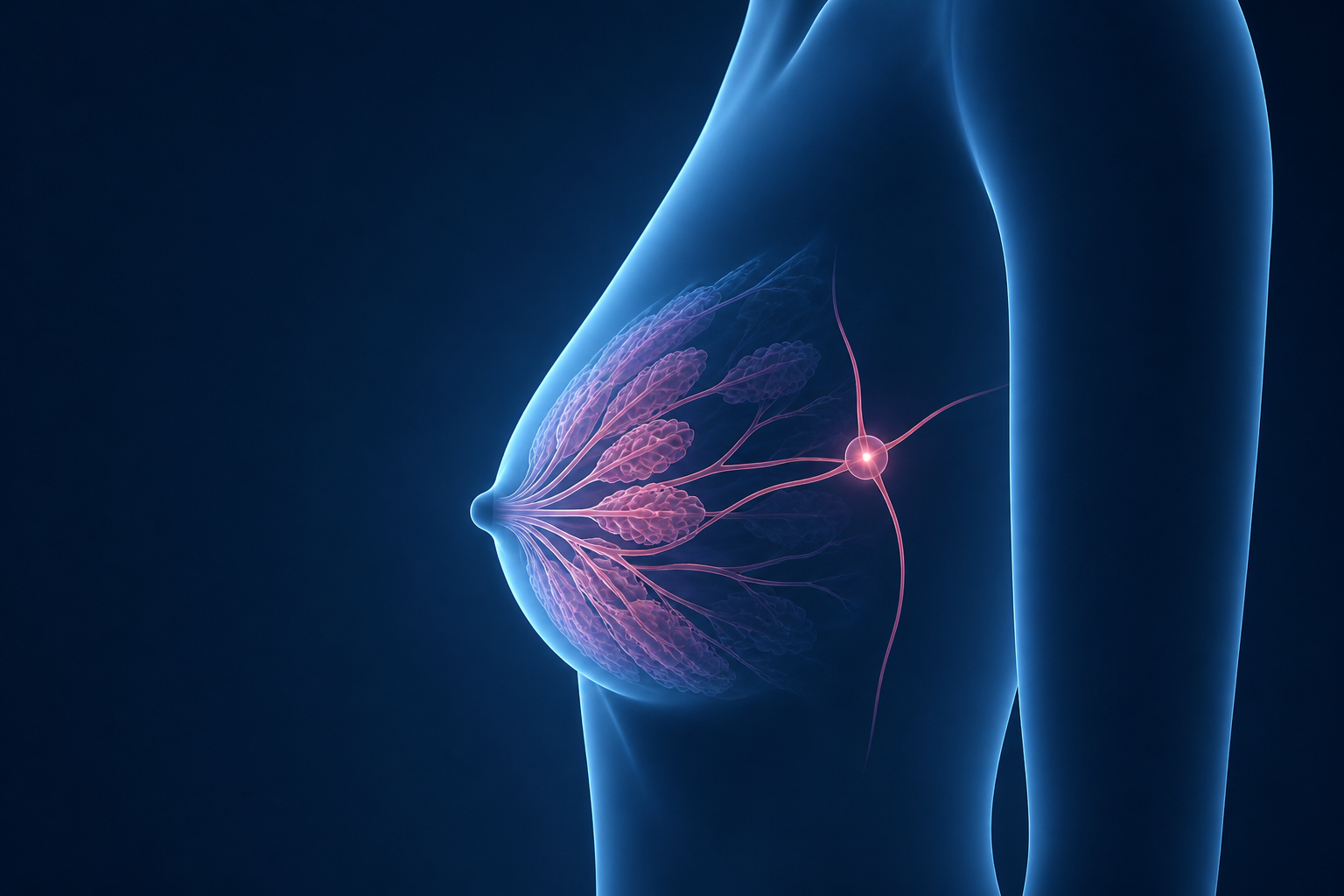
Fibroadenomas are not cancer. A typical fibroadenoma in a patient under 40 with all reassuring imaging features is assigned BI-RADS 3 - meaning less than 2% chance of malignancy. Most stable fibroadenomas in younger women are observed without biopsy.
What Exactly Is a Fibroadenoma?
A fibroadenoma forms when glandular tissue and fibrous supporting tissue grow together into a smooth, rubbery, well-defined lump. Fibroadenomas are hormone-sensitive - they tend to grow during periods of high estrogen (pregnancy, adolescence) and often shrink or calcify after menopause.
On ultrasound, a typical fibroadenoma appears as a hypoechoic, oval, well-circumscribed mass that is wider than it is tall. On mammography, it may appear as a smooth, low-density oval mass, or if old, with large coarse "popcorn" calcifications.
Reassuring vs. Concerning Features
✓ Reassuring Features
- Oval or round shape
- Circumscribed (smooth) margins
- Parallel orientation on ultrasound (wider than tall)
- Uniform internal echo texture
- Stable size on prior imaging
⚠ Concerning Features
- Irregular or non-circumscribed margins
- Rapid growth between imaging appointments
- Fine irregular internal calcifications
- New or growing mass in a woman over 40 or postmenopausal
Types of Fibroadenoma
Simple Fibroadenoma
Classic type. Well-defined, uniform, no increased breast cancer risk. Most common presentation.
Complex Fibroadenoma
Contains cysts larger than 3mm, sclerosing adenosis, or papillary changes. Slightly elevated relative risk (~1.5–2×). Biopsy is generally recommended.
Giant Fibroadenoma
Larger than 5 cm. May require surgical removal due to size and cosmetic concerns.
Juvenile Fibroadenoma
Occurs in adolescents. Can grow rapidly - monitoring is important.
Calcified Fibroadenoma
"Popcorn" calcification pattern - large, coarse chunks. BI-RADS 2 - definitively benign. No biopsy needed.
Is This Cancer?
Fibroadenomas are not cancer. However, a rare tumor called a phyllodes tumor can look identical to a fibroadenoma on imaging - this is one reason biopsy is often recommended in older women or when a mass is large or growing. Phyllodes tumors are uncommon and most are benign, but some are borderline or malignant and require surgical removal.
What Happens Next
Short-interval ultrasound to confirm stability, then annually for 2 years.
Age lowers the threshold for tissue confirmation.
Image-guided core needle biopsy to confirm diagnosis.
Continue standard surveillance mammography.
When Should I Be Concerned?
Seek prompt evaluation if:
- The lump is new and you are over 35 or postmenopausal
- A fibroadenoma grows noticeably between imaging appointments
- It changes in shape or character on imaging
- A biopsy is recommended by your radiologist
Related Topics
Does your report mention a fibroadenoma or probable fibroadenoma? The BI-RADS category (2 or 3) tells you what happens next. A board-certified radiologist with subspecialty breast imaging experience can walk you through it step by step.
Get My Report Explained